
Below-grade floors in KCK and the metro
Basement Floor Epoxy in Kansas City, KS
We find out what the ground under your slab is doing, then pick a coating that can live with it.
- Free on-site estimate with a slab and moisture check
- Written price that lists every prep step and coat
- Floors ground with diamond tooling, never just acid washed
A Lower Level Built on River-Country Ground
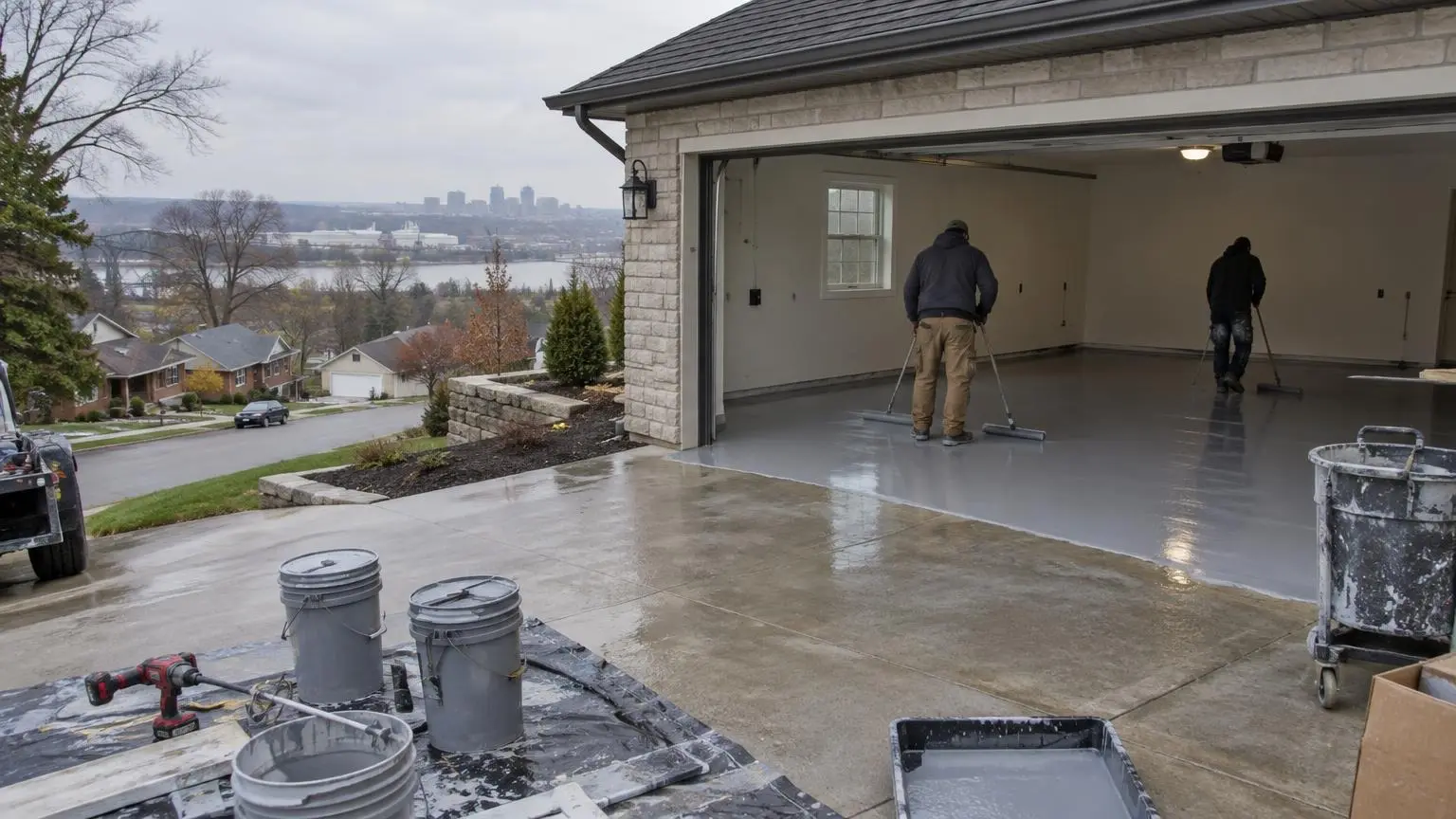
Basement floor epoxy is how a lot of Kansas City, Kansas homeowners turn a bare lower level into a room they use every day. Think of a laundry area you can hose off, a weight room, a kids' play space or a bar for watching the Chiefs. The coating itself is the easy part. What matters more is the slab below it and the ground below that. Wyandotte County sits where two big rivers meet, and our springs are wet. So every basement we price starts with a look at moisture.
Water from above and below
Kansas City gets close to 40 inches of rain and melted snow a year. Wikipedia lists 38.13 inches at the Downtown Airport and 39.30 at KCI, with much of it arriving in spring and early summer storms. The Kansas River forms part of the county's southern edge, and Wikipedia's county page notes that Turkey Creek has a long record of flooding. Your house does not need to be near a creek for this to matter. After a week of storms, the soil around a foundation stays damp. That moisture rises through the concrete as vapor, and vapor is what lifts a coating off a basement floor.
Signs we look for on the walk-through
- A white, chalky crust on the slab or along the bottom of the walls
- Dark patches that stay after the rest of the floor dries
- Old floor paint that bubbles or comes off in sheets
- A sump that runs often after rain
- A musty smell when the house has been closed up
None of these rule out a coating. They tell us which primer to use and whether something else needs fixing first.
Testing and what we do with the result
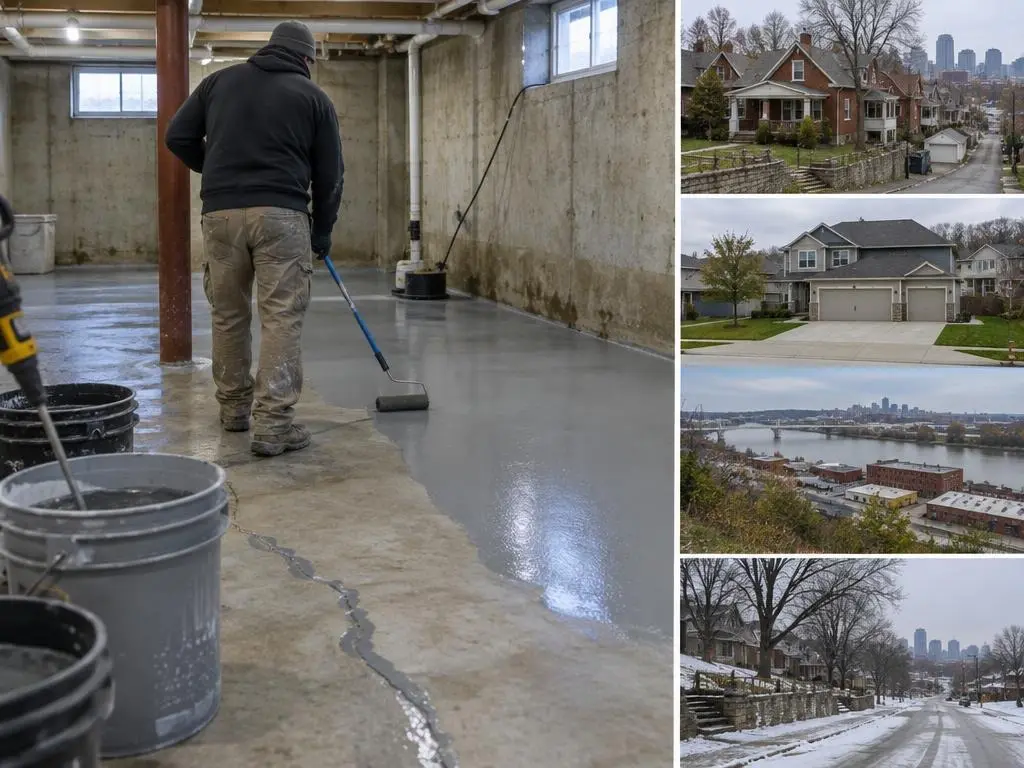
We tape a square of plastic to the slab and check under it for condensation, and we take meter readings in more than one spot. A dry slab gets a standard epoxy primer. A slab with some vapor coming through gets a moisture-tolerant primer made for that level. If water is running in at the cove joint, through a crack or around a pipe, we stop there. That leak needs a waterproofing fix before any floor goes down.
Basements in a city this age
Point2Homes, summarizing Census survey data for 2019 to 2023, puts the median KCK home at 1961. Almost half the housing stock went up before 1960. In those houses we often find old enamel floor paint, nine-inch tile with black glue under it, patches of mortar and slabs poured with no plastic sheet beneath them. Each of those gets ground off or tested before we coat. Newer homes out toward Piper and the Johnson County suburbs tend to have flatter, better slabs, though a corner near a downspout can still read damp after a storm.
Sticky July air
Our summers are humid. The EPA suggests keeping indoor humidity under 60 percent, and ideally between 30 and 50. When warm air meets a cool slab it can bead up on the surface even if no water is coming from below. We ask you to run a dehumidifier for a few days before install day.
Radon is a separate job
A coating and filled cracks will not lower radon, and we never pitch them that way. The Kansas Radon Program says test kits are sold at county extension offices. Test before you finish the space. If you need a mitigation fan and pipe, it is easier to put that in first. We then coat around the pipe and the sump lid.
Picking a surface for the room
- Solid color epoxy: bright and easy to wipe, a good fit for laundry and storage.
- Flake broadcast: hides lint and dust and gives bare feet a little grip in a gym or playroom.
- Metallic pour: a glossy, swirled look for a bar or media room.
Light tones make a basement with small windows feel larger. Floor drains and cleanouts stay open and easy to reach.
Included in a Basement Job
Here is the work behind a basement coating, from the first reading to the last coat.
Slab moisture readings
Plastic-sheet and meter tests in several spots so the primer fits the slab.
Removal of old finishes
Enamel paint, sealer and tile glue ground away until clean concrete shows.
Crack and cove work
Cracks and the floor-wall joint filled where dry, with drains and the sump kept clear.
Primer matched to the test
Standard or moisture-tolerant epoxy primer, chosen from the readings.
Finish layer
Solid color, flake or metallic, sealed with a clear coat sized for the room.
What Basement Floor Epoxy Costs
| Item | Published range |
|---|---|
| Epoxy floor, installed, each square foot | $4 to $10 |
| Whole basement, about 300 to 2,000 sq ft | $1,200 to $20,000 |
| Moisture and hardness tests, if billed apart | $50 to $300 |
| Patching cracks and chipped spots | $25 to $250 |
| Resurfacing a badly worn slab, each sq ft | $3 to $7 |
These are national numbers from HomeGuide (epoxy, basement size, testing and resurfacing) and HomeAdvisor (patching). Old paint or tile glue, a moisture primer and crack work all push a basement up the range. Your written estimate is the price.
Our Basement Steps
1. Walk the room
We measure, note drains and the sump, and look for damp spots and old finishes.
2. Read the slab
Moisture tests decide the primer, and we write that choice into the quote.
3. Grind and fill
A vacuum-connected grinder strips the surface, then cracks and the cove get filled.
4. Prime, coat and air out
Primer and finish go on while fans move air out of the room.
Basement Floor Epoxy Questions
My basement smells musty. Can it still be coated?
Often, yes. A musty smell usually means damp air or some vapor through the slab. We test, and if the readings are moderate a moisture-tolerant primer can handle it. If water is leaking in, that gets fixed first.
What does a basement floor coating run in Kansas City?
HomeGuide lists installed epoxy at $4 to $10 a square foot and whole basements from about $1,200 to $20,000. Paint removal, tile glue, a moisture primer and crack work add to it. We quote after we test your slab.
Will a coating help with radon?
No. Sealing a floor is not radon mitigation. Test with a kit from your county extension office, put in any mitigation system you need, and coat after that.
Can you coat over the old gray paint on my basement floor?
We grind it off. Old floor paint is often loose in spots, and new epoxy is only as strong as whatever it sits on. Grinding gets us to bare concrete.
Basement Floor Epoxy Service Areas
- Epoxy Flooring in Kansas City, KS
- Epoxy Flooring in Bonner Springs, KS
- Epoxy Flooring in Edwardsville, KS
- Epoxy Flooring in Overland Park, KS
- Epoxy Flooring in Olathe, KS
- Epoxy Flooring in Shawnee, KS
- Epoxy Flooring in Lenexa, KS
- Epoxy Flooring in Merriam, KS
- Epoxy Flooring in Mission, KS
- Epoxy Flooring in Roeland Park, KS
- Epoxy Flooring in Prairie Village, KS
- Epoxy Flooring in Leawood, KS
- Epoxy Flooring in De Soto, KS
- Epoxy Flooring in Basehor, KS
- Epoxy Flooring in Lansing, KS
- Epoxy Flooring in Leavenworth, KS
- Epoxy Flooring in North Kansas City, MO
- Epoxy Flooring in Riverside, MO
- Epoxy Flooring in Parkville, MO
- Epoxy Flooring in Gladstone, MO
- Epoxy Flooring in Independence, MO
Get a Basement Floor Epoxy Estimate
Free basement estimates in KCK and nearby, with a moisture reading on the slab.