
Short downtime, sun-safe color
Polyaspartic Floor Coating in Kansas City, KS
A coating that sets in hours, handles cold slabs, and keeps its color when the garage door stays up.
- Free on-site estimate with a slab and moisture check
- Written price that lists every prep step and coat
- Floors ground with diamond tooling, never just acid washed
Fast Floors for a Two-Season Town
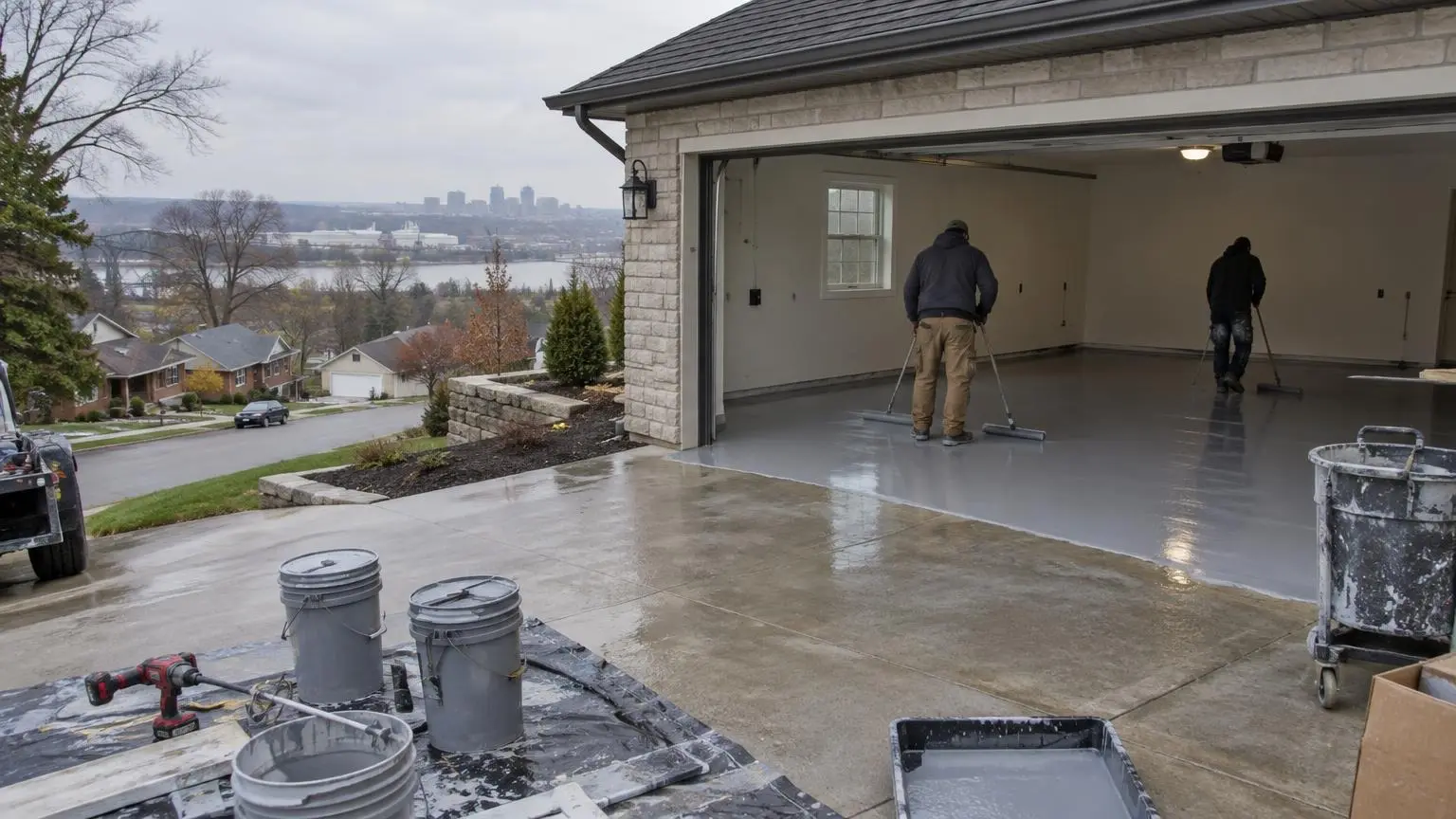
Polyaspartic floor coating is what we reach for in Kansas City, Kansas when time or sunlight is the main concern. It is an aliphatic polyurea. In plain terms, it cures fast and holds its color. HomeGuide says a polyaspartic floor is ready for heavy vehicles in 24 to 48 hours. Standard epoxy can need up to a week. For a household with one garage and two cars, or a shop that loses money every closed day, that gap is a big deal.
January slabs and July sun
Kansas City asks a lot of a coating in both directions. Wikipedia's figures for the Downtown Airport show a January average low of 22.2°F and a July average high of 90.2°F. In winter, a detached garage off a KCK alley can hold a slab too cold for plain epoxy to cure well. HomeGuide gives polyaspartic an application range of minus 30°F to 140°F, which is far wider than epoxy. Every product still lists its own limits, so we read slab temperature with a thermometer and bring heat when it is needed. In summer the problem flips. Low afternoon sun pours through an open door onto the floor, and plain epoxy tends to yellow there. HomeGuide rates polyaspartic UV resistance as excellent and epoxy as poor to fair.
Humidity speeds it up
Our summer air is thick. Angi's Kansas City cost guide notes that humidity can drag out epoxy cure times. Polyaspartic does the opposite, because it reacts with moisture in the air. On a muggy August morning it can start to set in the pail sooner than the label says. We mix smaller amounts, keep a steady pace and watch the hygrometer.
Three ways we use it
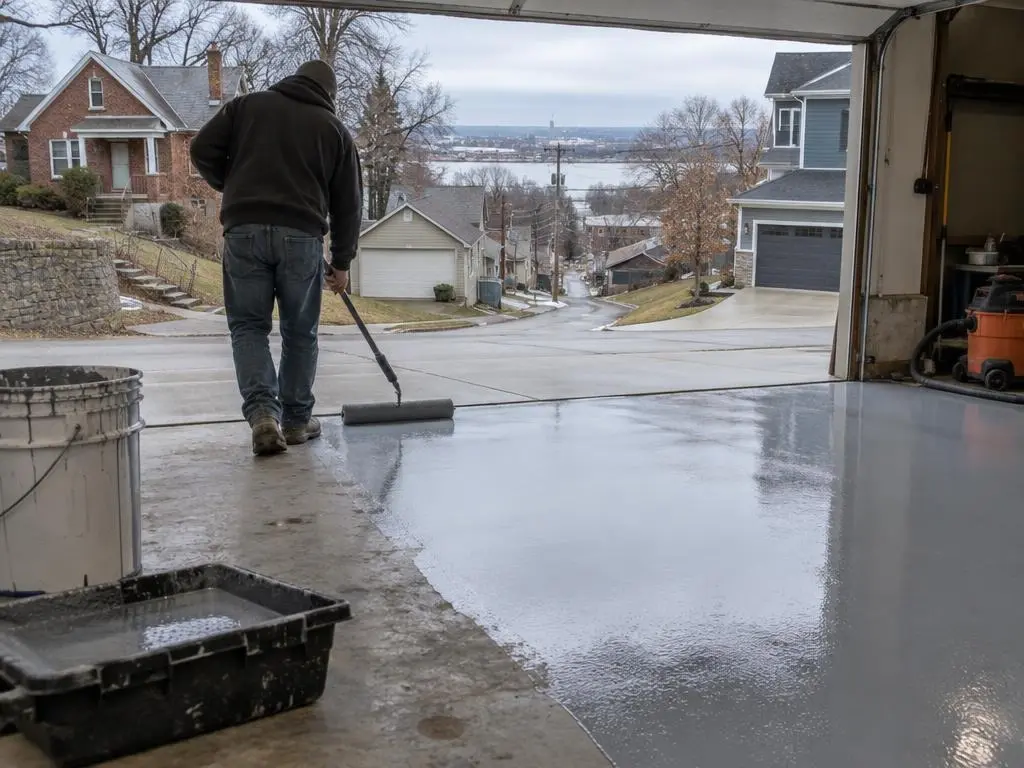
- Clear coat on top of epoxy: an epoxy base builds thickness and bond, and a polyaspartic layer on top takes the sun, scuffs and road brine.
- All-polyaspartic floor: every layer is polyaspartic. This is the fastest route and our usual pick for cold-month jobs.
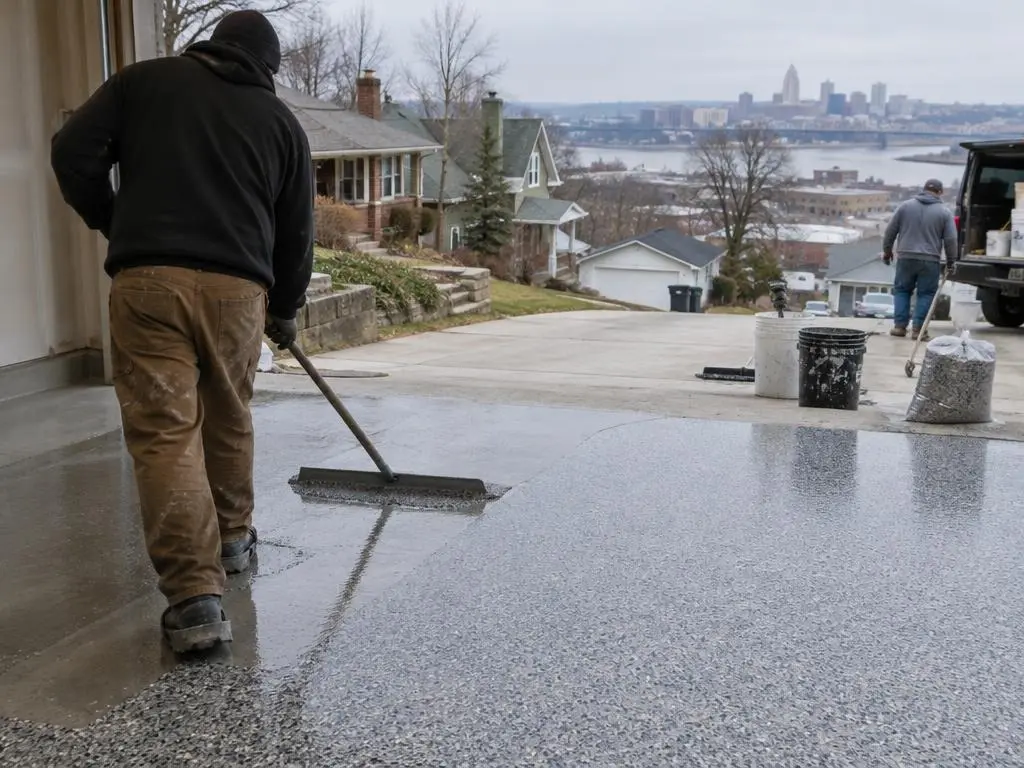
- Seal over a flake broadcast: the clear polyaspartic layer locks chips in place and keeps the blend from yellowing near the door.
Where it earns the extra cost
Polyaspartic makes sense for a west-facing garage, a covered patio or porch slab, a sunroom on concrete, and a storefront or service bay that can only shut for a day. It is also handy for families who need the car back inside before the next ice storm. Kansas City still remembers the 2002 storm that cut power across the region for days.
Where epoxy still makes sense
Polyaspartic is not the answer for every floor. HomeGuide lists it at $5 to $12 a square foot against $4 to $10 for epoxy. It also goes on thinner, at 2 to 6 mils a coat compared with 10 to 20 for epoxy. Under forklifts, or on a rough slab that needs build, we often use an epoxy body coat and finish with polyaspartic. On a damp basement slab, the moisture fix happens in the primer, whatever sits on top. Your quote will say which mix we picked and why.
What a quick install looks like
On many garages we finish in a single day. We grind and vacuum in the early hours, fill cracks, then lay the base and broadcast. After lunch we scrape the loose chips and roll the clear coat. Because the working time is short, every crack and joint is done before the first kit is opened. HomeGuide says the surface is dry to the touch within a few hours. We give you a written time to walk on it and a time to park, based on the product and the weather that day.
Keeping it looking new
Sand and grit scratch any clear coat, so sweep often. In winter, squeegee the brine out the door and rinse every few weeks. Use a pH-neutral cleaner. A rubber mat under a motorcycle kickstand or a jack stand keeps point loads off the finish. HomeGuide puts home polyaspartic floors at roughly 10 to 20 years or more when they are well installed and cared for.
Polyaspartic Options
We can build the whole floor from polyaspartic or use it as the final layer.
UV-stable clear layer
A polyaspartic top layer over an epoxy or chip base so color holds near open doors.
All-polyaspartic build
Every coat polyaspartic for the shortest wait before you use the floor.
Winter scheduling
Slab temperature checked and the space heated so cold-month jobs cure right.
Same-day garage
Grind, repair, base, chips and clear coat finished in one visit when the slab allows.
What Polyaspartic Floor Coating Costs
| Item | Published range |
|---|---|
| Installed, each square foot | $5 to $12 |
| Single-car garage, 288 to 392 sq ft | $1,400 to $4,700 |
| Double garage, 400 to 576 sq ft | $2,000 to $6,900 |
| Triple garage, 576 to 864 sq ft | $2,900 to $10,400 |
| Major repair or resurfacing, extra per sq ft | $1 to $5 |
| Moisture and hardness tests | $50 to $300 |
All figures are national ranges from HomeGuide's polyaspartic cost guide. Prices in the Kansas City area can run different, and chips, crack repair and moisture primers change the total. Your written estimate is the price.
Our Polyaspartic Steps
1. Measure conditions
We take moisture, slab temperature and humidity readings, then choose products that will cure in them.
2. Finish the prep
Diamond grinding, vacuuming and every repair are done before mixing starts.
3. Lay it down fast
Small batches rolled evenly inside the product's short open time.
4. Hand the floor back
You get written walk and park times that fit the product and the day's weather.
Polyaspartic Floor Coating Questions
Will a polyaspartic floor turn yellow in my garage?
It is made to hold its color. HomeGuide rates its UV resistance as excellent, compared with poor to fair for epoxy. That is why we often use it as the top layer even over an epoxy base.
Can you install it in December or January?
Often, yes. HomeGuide lists a much wider temperature range for polyaspartic than for epoxy. We still check the slab with a thermometer and heat the garage if the product sheet calls for it.
How soon can I park after a polyaspartic install?
HomeGuide puts heavy vehicle use at 24 to 48 hours. A cold slab slows that and humid air speeds it up. We give you a written time for your floor.
Why does polyaspartic cost more than epoxy?
The material costs more, and the short working time takes a skilled crew working in small batches. HomeGuide lists $5 to $12 a square foot against $4 to $10 for epoxy.
Polyaspartic Floor Coating Service Areas
- Epoxy Flooring in Kansas City, KS
- Epoxy Flooring in Bonner Springs, KS
- Epoxy Flooring in Edwardsville, KS
- Epoxy Flooring in Overland Park, KS
- Epoxy Flooring in Olathe, KS
- Epoxy Flooring in Shawnee, KS
- Epoxy Flooring in Lenexa, KS
- Epoxy Flooring in Merriam, KS
- Epoxy Flooring in Mission, KS
- Epoxy Flooring in Roeland Park, KS
- Epoxy Flooring in Prairie Village, KS
- Epoxy Flooring in Leawood, KS
- Epoxy Flooring in De Soto, KS
- Epoxy Flooring in Basehor, KS
- Epoxy Flooring in Lansing, KS
- Epoxy Flooring in Leavenworth, KS
- Epoxy Flooring in North Kansas City, MO
- Epoxy Flooring in Riverside, MO
- Epoxy Flooring in Parkville, MO
- Epoxy Flooring in Gladstone, MO
- Epoxy Flooring in Independence, MO
Get a Polyaspartic Floor Coating Estimate
Free polyaspartic estimates across Kansas City, KS and the nearby metro.